

1. The “Big Four” Raw Materials of a PVC Hose
A PVC hose may look like one single colored tube, but it is actually the product of a carefully tuned recipe. The core ingredients fall into four groups:
1.1 PVC Resin — The Skeleton
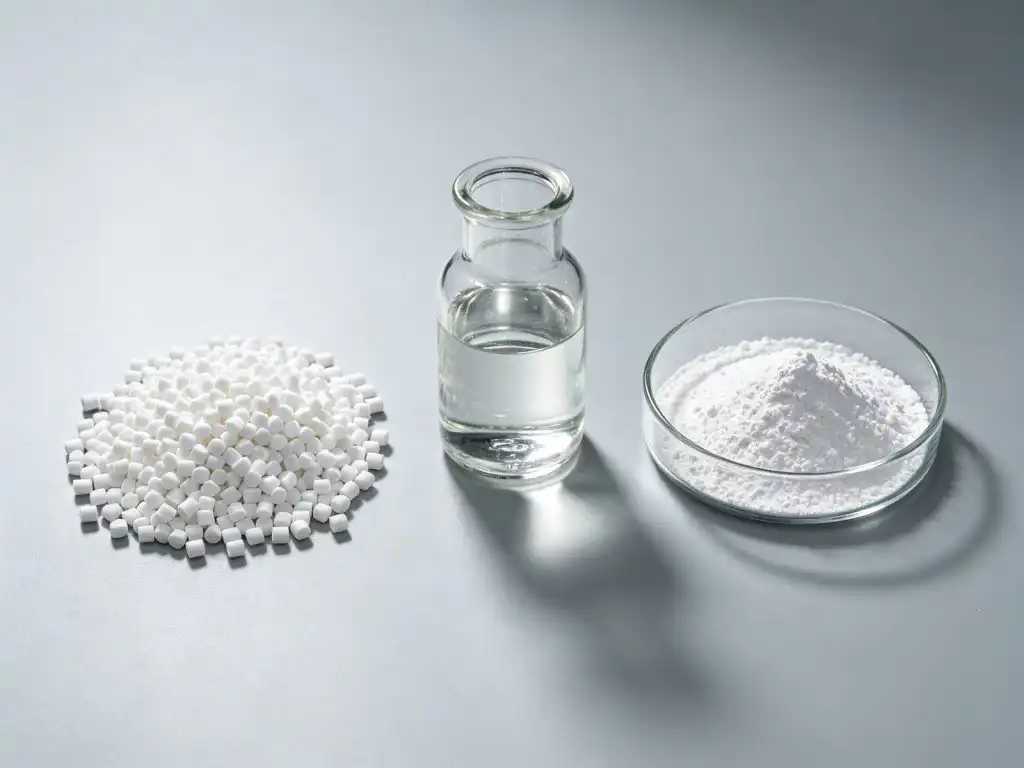
PVC stands for Polyvinyl Chloride, a polymer made by polymerizing vinyl chloride monomers. It is the largest ingredient in the recipe, typically making up more than half of the total mass.
As it leaves the chemical plant, PVC resin is a white powder or granule. Here is the key point: pure PVC by itself is hard and brittle. It could never be called a “soft hose” without the next ingredient.
For hose extrusion, suspension-grade PVC resin (SG series) is the standard choice because of its even particles, good flow behavior, and excellent extrudability.
1.2 Plasticizer — The Secret That Makes It Soft
This is the single most important ingredient for a flexible hose. Pure PVC molecules are packed tightly together by strong intermolecular forces, which makes the material rigid. When plasticizer molecules slip in between the PVC chains, they push the chains apart and weaken those forces—so the material becomes soft, bendable and elastic.
Common plasticizers include:
- Traditional phthalates: DOP (di-2-ethylhexyl phthalate), DBP, DINP—low cost and widely used in the past, but some are being phased out over health and environmental concerns.
- Eco-friendly alternatives: DOTP (dioctyl terephthalate), TOTM (trioctyl trimellitate), ATBC (acetyl tributyl citrate), and polyester plasticizers—low volatility, low migration, preferred for food-contact, medical, and export-grade products.
The amount of plasticizer directly controls the “softness”: more plasticizer means a softer, clearer hose; less means a stiffer one.
1.3 Heat Stabilizer — The Guardian During Processing
PVC has one sensitive side: it hates heat. At extrusion temperatures of roughly 160–180°C, PVC can begin to decompose and release hydrogen chloride, which causes discoloration, brittleness, and even blackening.
Heat stabilizers prevent this breakdown. The industry has gone through three generations:
- Lead salt stabilizers (lead stearate, etc.): cheap and common in the early days, but phased out due to heavy-metal concerns.
- Calcium-Zinc (Ca/Zn) composite stabilizers: the current mainstream, non-toxic and eco-friendly. In 2023 they already accounted for over 90% of PVC hose applications in China.
- Organotin stabilizers: used for high-clarity, high-performance tubing, at a higher cost.
1.4 Other Additives — Small but Essential
Beyond the three main players, the recipe often includes:
- Lubricants (stearic acid, polyethylene wax): keep the compound from sticking to the screw and improve flow.
- Fillers (calcium carbonate, etc.): lower cost and adjust stiffness, but too much hurts transparency.
- Colorants: give the hose its blue, green, gray or other shades.
- Coupling agents / processing aids: improve dispersion and surface finish.
2. From Powder to Tube: How a PVC Hose Is Born
Once the ingredients are mixed, they still need to go through a standard extrusion line:
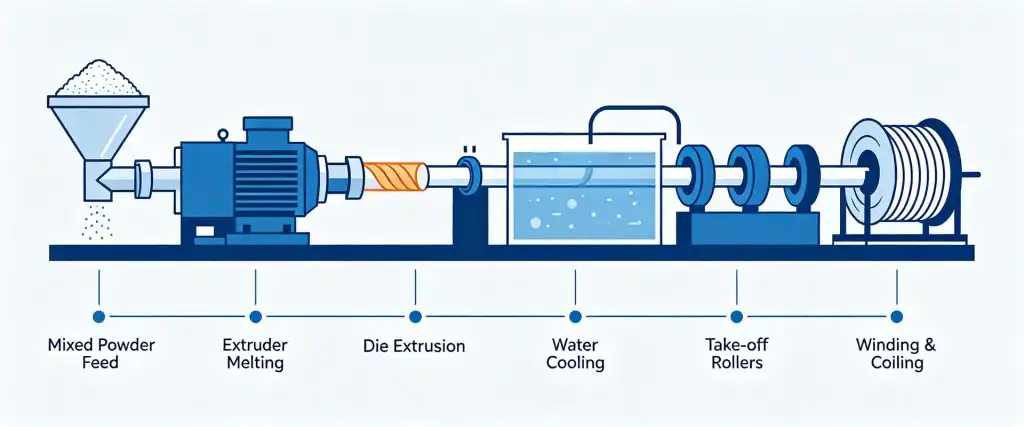
Step 1: High-Speed Mixing
PVC resin, plasticizer, stabilizer, lubricant and colorant are loaded into a high-speed mixer according to the recipe. With heat and agitation, the powder absorbs the liquid plasticizer and forms a uniform “dry blend.” This step determines batch-to-batch consistency.
Step 2: Extrusion and Melting
The blend feeds into a single-screw extruder. The screw rotates to push the material forward while the barrel heats it in zones:
- Feed zone: ~100–120°C
- Compression zone: ~120–140°C
- Metering zone: ~140–160°C
Under heat and shear, the powder melts into a viscous melt and is pushed through a precision annular die, emerging as a continuous tube-shaped parison.
Step 3: Cooling and Sizing
The freshly extruded tube is still soft. It immediately enters a vacuum cooling tank where water sprays and air knives solidify it quickly, while a vacuum sizing sleeve fixes the outer diameter precisely. Cooling speed and take-off speed also affect clarity: faster, more stable cooling generally yields a clearer tube.
Step 4: Take-off and Coiling
The cooled tube is pulled by take-off rollers, checked online for diameter and wall thickness, and finally wound into coils by a winder. For reinforced hoses (steel wire or braided fiber), additional steps add a braided/wound reinforcement layer and a second outer PVC extrusion after the inner tube is formed.
From powder to a coiled, clear hose, the whole line typically takes only seconds to minutes.
3. Why Can a PVC Hose Bend and Fold?
Back to the opening question: why is pure PVC rigid, but a PVC hose soft and flexible?
The answer is the plasticizer. Picture PVC polymer chains stacked neatly in layers. Strong forces between chains make the bulk material hard. Plasticizer molecules act like tiny spacers and lubricants—inserting themselves between the chains, pushing them apart, and letting them slide past one another. At the macroscopic level, the material becomes soft, bendable, and elastic.
More plasticizer means a softer, clearer hose; less means a stiffer, more semi-transparent one. That is why the market offers everything from ultra-soft medical-grade tubing to fairly rigid industrial fluid lines—it is all a matter of formulation ratios.
Closing Thoughts
An unassuming PVC hose is actually the meeting point of polymer chemistry, plasticizer science, heat-stabilizer technology and extrusion engineering. It is cheap, lightweight, chemically resistant, and available in clear or colored versions—reasons why it has become one of the most common tubes in everyday life.
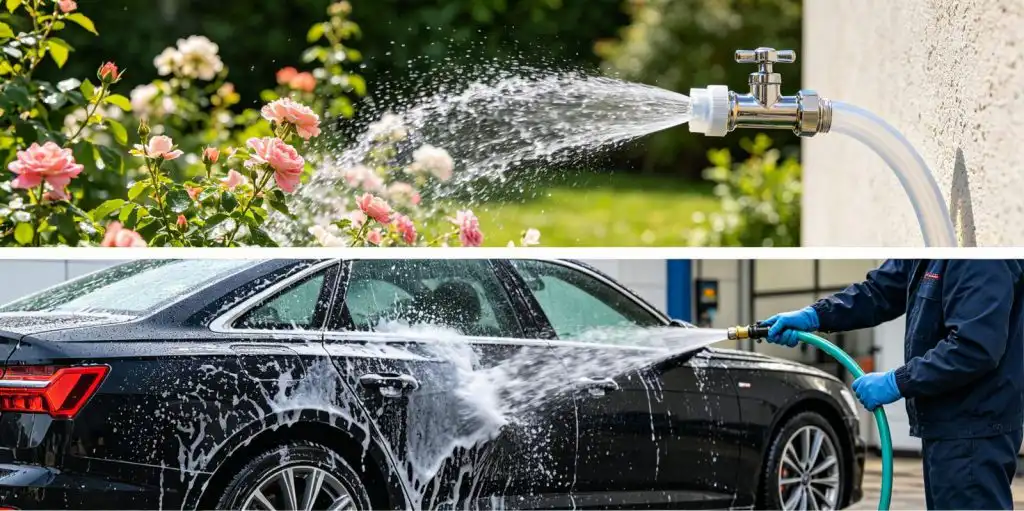
Next time you see a watering tube, a car-wash hose, or a thin transparent line in a lab, you may remember: inside there is PVC resin, plasticizer that makes it soft, and a stabilizer quietly protecting the process. They meet in the extruder, cool down, and become the tube in your hand.
References
- Qingdao Sainuo Chemical: PVC Clear Hose Reference Formulation and Raw-Material Analysis
- Weifang Sansen Machinery: Raw-Material Requirements for a PVC Fluid Hose Extrusion Line
- Industry Report: 2025 China PVC Fluid Hose Data Monitoring Research Report
- Shandong Mingqi Hose Industry: 18,000 T/Y PVC Hose Production Process Description